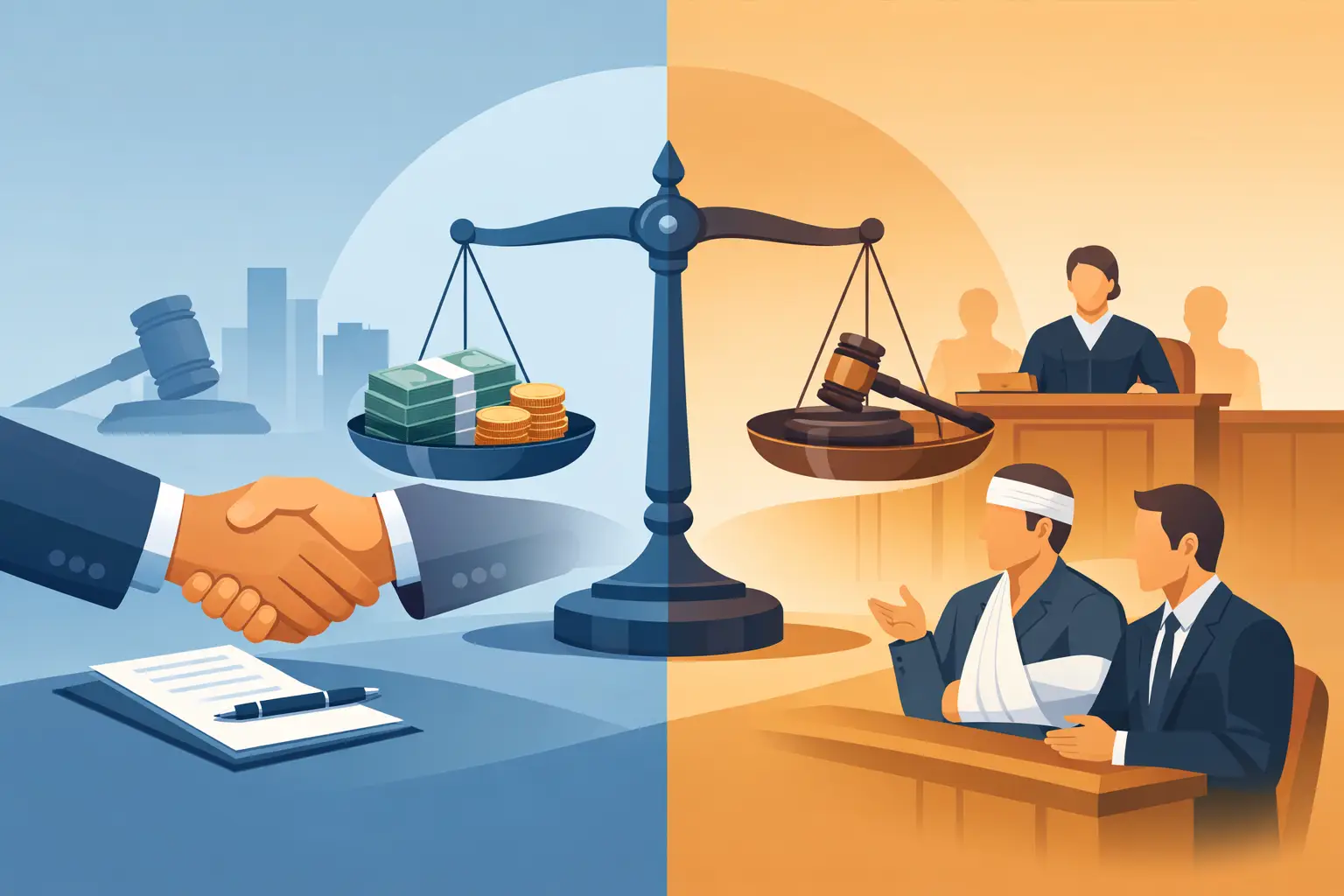


Settlement vs Trial Injury Case: Which Is Right?
The first settlement offer can arrive when you are still in pain, missing work, and trying to understand what happened. In a settlement vs trial injury case decision, the question is not simply whether to take money now or fight later. It is whether the offer accounts for the full harm an accident has caused – and whether the risks and demands of trial are justified by the facts.
For injured people in Lafayette and across Acadiana, that decision can affect medical care, household income, and the stability of an entire family. A fair answer requires a close look at the evidence, the insurance coverage, your recovery, and the other side’s willingness to deal honestly.
What a Settlement Means After an Injury
A settlement is a negotiated agreement that resolves a claim without taking it to a jury verdict. In exchange for compensation, the injured person generally signs a release ending the claim against the responsible parties covered by that agreement.
Settlements are common for good reason. They provide certainty. Once an agreement is reached and the necessary paperwork is completed, payment is usually much closer than the end of a contested lawsuit. That can matter when medical bills are mounting, a paycheck has stopped, or a family is trying to keep up with ordinary expenses after a serious crash or workplace injury.
A settlement also gives both sides control. There is no jury deliberation, no uncertain verdict, and no appeal delaying the final result. For some clients, especially those who need closure and have a well-supported offer that covers their losses, that certainty is valuable.
But a quick settlement is not automatically a fair settlement. Insurance companies often seek to resolve claims before the full extent of an injury is clear. A back injury, traumatic brain injury, shoulder damage, or post-traumatic stress can develop into a longer and more costly problem than it first appears. Once a release is signed, reopening the claim is usually not an option.
When Taking an Injury Case to Trial May Make Sense
A trial places the dispute before a judge or jury. Lawyers present evidence, question witnesses, challenge the other side’s version of events, and ask the jury to decide responsibility and damages.
Trial may be the right path when an insurer refuses to accept clear evidence, disputes who caused the accident, downplays a serious injury, or will not make an offer that reflects documented losses. It can also become necessary when the parties disagree sharply about future medical care, lost earning capacity, pain and suffering, or the value of a wrongful death claim.
For example, a commercial truck collision may leave an injured driver unable to return to physically demanding work. The insurer might focus on current medical bills while overlooking future treatment, reduced income, and the impact on a worker’s ability to support a family. If negotiation does not produce a meaningful offer, a trial can give the injured person a chance to fully present that loss.
The possibility of trial also changes settlement negotiations. An insurance company is more likely to take a claim seriously when it knows the attorney has investigated the case, preserved evidence, prepared experts when needed, and is ready to put the facts before a jury. Courtroom readiness is not about chasing a trial for its own sake. It is about refusing to let an insurer dictate the value of a person’s life-changing injury.
Settlement vs Trial Injury Case: The Real Trade-Offs
There is no single answer that fits every injury claim. A settlement can offer speed and certainty. A trial can offer the opportunity for fuller accountability and potentially greater compensation. Each path carries trade-offs.
A trial takes time. Litigation may involve depositions, medical examinations, expert analysis, court hearings, and months or longer of preparation. The other side will scrutinize medical records, employment history, prior injuries, and every detail of the accident. Testifying can be stressful, particularly for someone still recovering from trauma.
There is also risk. Even a strong case can face an unpredictable jury, disputed evidence, or legal rulings that limit what can be presented. A verdict may be lower than an offer that was available earlier. In some cases, the jury may find that more than one person shared fault, which can affect recovery under Louisiana law.
On the other hand, accepting too little creates its own risk. If a settlement does not cover future surgery, rehabilitation, medications, home assistance, lost wages, or reduced ability to earn a living, the financial burden does not disappear. It shifts to the injured person and family after the case is closed.
The goal is not to choose the fastest route or the most dramatic one. The goal is to make an informed choice based on what your claim is truly worth and what can realistically be proven.
Facts That Shape the Right Decision
The strength of liability evidence is often the first consideration. A police report, photographs, video, witness statements, vehicle data, safety records, and physical evidence can all affect leverage. In offshore, maritime, construction, and other workplace cases, maintenance logs, training records, incident reports, and employer safety practices may become especially important.
The nature of the injury matters just as much. A claim should account for more than the emergency room bill. It may include follow-up care, specialists, therapy, prescriptions, future treatment, lost income, lost business income, physical pain, emotional distress, and loss of enjoyment of life. In fatal accident cases, families may also face funeral expenses and the loss of financial and personal support.
Available insurance coverage and assets matter, too. A devastating injury does not automatically mean unlimited recovery. Identifying all potential defendants and insurance policies is a critical part of evaluating the case. In a truck accident, for instance, the driver, trucking company, cargo company, maintenance provider, or another party may have played a role.
Timing can be decisive. Louisiana injury claims are subject to legal deadlines, and evidence can disappear quickly. Waiting too long to seek legal advice can make it harder to preserve video footage, inspect vehicles, locate witnesses, and build the record needed for either a fair settlement or a strong trial presentation.
Do Not Let an Early Offer Set the Value of Your Claim
An adjuster may sound sympathetic and still be working toward the insurer’s financial interests. Early offers often arrive before a person knows whether treatment will work, whether surgery is needed, or when they can return to work. They may also fail to account for liens, out-of-pocket costs, and future losses.
Before accepting an offer, ask whether you have reached maximum medical improvement or whether your doctors can reasonably project future care. Ask what evidence supports the wage-loss calculation. Ask whether all responsible parties and available policies have been identified. Most of all, ask what rights you give up by signing a release.
These questions are not meant to create fear. They are meant to prevent a rushed decision during one of the hardest periods of your life.
A Trial-Ready Approach Can Protect Your Options
A lawyer does not need to force every case into court to prepare it as though it could go there. Thorough preparation often puts a client in the best position to settle because the insurer can see the proof, the damages, and the readiness to proceed if necessary.
At McConnell Law Offices, the focus is on seeing an injury claim from every angle: the accident itself, the insurance issues, the medical consequences, and the financial pressure placed on a family. That preparation helps clients understand the options in front of them without being pushed toward a decision that serves someone else’s timetable.
A settlement can be a strong result when it is fair, timely, and sufficient for the losses involved. A trial can be the right answer when the other side refuses to recognize the truth of what happened. The best path is the one that gives your injury, your work, and your family’s future the respect they deserve.