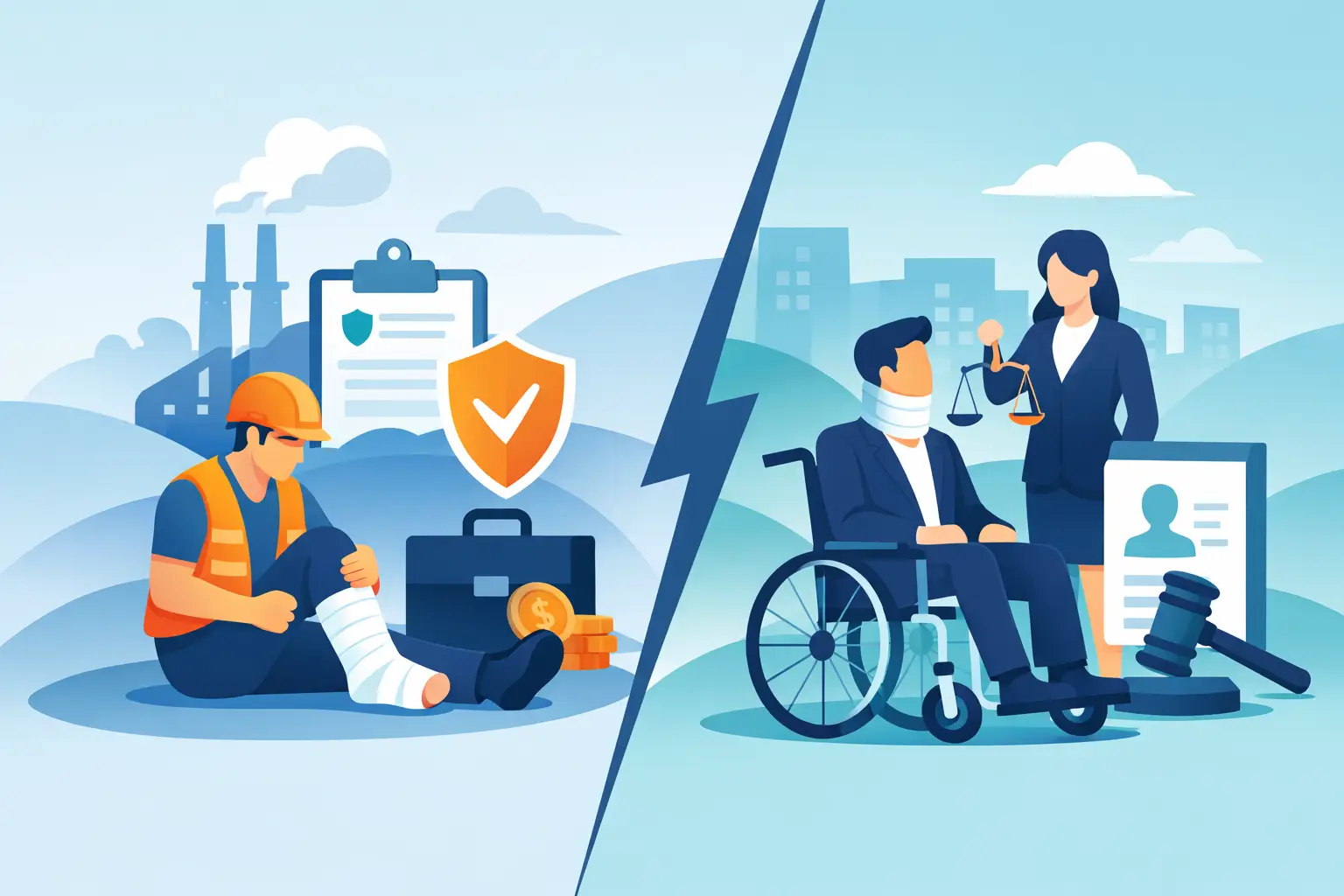


Workers Compensation vs Personal Injury
A back injury on the job can leave you with the same pain, missed paychecks, and stress as a crash on Johnston Street. But when the legal claim starts, workers compensation vs personal injury becomes a critical question. The answer shapes who pays your medical bills, whether fault matters, and what money may be available for your recovery.
For injured people in Louisiana, this distinction is not academic. It affects how quickly benefits begin, whether you can recover pain and suffering, and whether more than one claim may be available after a serious accident. If you choose the wrong path or assume one claim covers everything, you can leave meaningful compensation on the table.
Workers compensation vs personal injury: the basic difference
Workers’ compensation is a system designed for employees hurt in the course and scope of their job. In most cases, you do not have to prove your employer did something wrong. If the injury happened while you were performing work duties, workers’ comp may cover medical treatment and part of your lost wages.
A personal injury claim is different. It is based on fault. You must show that another person or company acted negligently or wrongfully and caused your injury. If you can prove that, you may pursue a broader range of damages than workers’ comp usually allows.
That is the core difference. Workers’ comp is generally a no-fault benefits system. Personal injury is a fault-based civil claim.
What workers’ compensation usually covers
Workers’ comp is meant to provide prompt, limited benefits. In Louisiana, that often means payment of reasonable and necessary medical care related to the work injury, along with indemnity benefits for lost wages if your injury keeps you from working or reduces your earning ability.
That sounds straightforward, but disputes are common. Insurance companies may question whether the injury really happened at work, whether treatment is necessary, or whether you are able to return to your job. Injured workers are often surprised to learn that workers’ comp does not simply pay every loss tied to an accident.
In most situations, workers’ compensation does not provide damages for pain and suffering. It also does not usually pay the full amount of your lost income. That gap matters when an injury is serious, recovery is long, and household bills keep coming.
What a personal injury claim can include
A personal injury case is built to compensate the full harm caused by someone else’s negligence. Depending on the facts, that can include medical expenses, lost wages, future medical care, loss of earning capacity, and damages for physical pain, mental anguish, and reduced quality of life.
That wider scope is why personal injury claims are often financially larger than workers’ comp claims. The trade-off is that they are harder to prove. You must establish fault, show how the injury happened, and connect your losses to the defendant’s conduct.
That process may involve witness statements, accident reports, medical records, expert opinions, and litigation. When insurers resist, the case may need to be tried before a judge or jury.
Why fault matters in one claim but not the other
If you slip while carrying equipment at work, workers’ comp may still apply even if no one was careless. That is the point of the system. It avoids the need to prove negligence in exchange for limited benefits.
In a personal injury claim, fault is central. If another driver ran a red light and hit you while you were making deliveries, that driver’s negligence may support a personal injury case. If a subcontractor created a dangerous condition at a job site, that may also support a civil claim.
This is where many people get tripped up. They think being hurt at work always means workers’ comp is the only option. Often it is the primary claim against the employer. But if a third party caused the accident, a personal injury claim may exist alongside the workers’ comp case.
Can you have both workers’ comp and a personal injury claim?
Yes, in some cases you can. This often happens when someone is injured on the job by a person or company other than the employer or co-worker. A delivery driver struck by a negligent motorist, an offshore worker injured by defective equipment, or a contractor hurt by another company’s unsafe conduct may have overlapping claims.
In that situation, workers’ comp may provide immediate wage and medical benefits, while the personal injury claim seeks fuller damages from the responsible third party. These cases require careful handling because reimbursement and credit issues can arise between the claims.
This is one reason early legal advice matters. What looks like a simple work injury may actually involve a vehicle claim, premises liability claim, product liability claim, or maritime issue.
Workers compensation vs personal injury in real-world Louisiana situations
In Acadiana, many people work in physically demanding jobs where legal lines can blur fast. A refinery worker may be hurt because an outside contractor ignored safety rules. A construction worker may fall because rented equipment failed. A worker driving between sites may be hit by a distracted driver.
Each of those examples raises a different question. Is this only a workers’ comp case? Is there a third-party personal injury claim? Does federal law or maritime law apply? The answer depends on the employment relationship, where the accident happened, who caused it, and what insurance policies are in play.
That is why broad assumptions are risky. Two injuries can look similar medically and still lead to very different legal claims.
The biggest trade-offs injured workers should understand
Workers’ compensation is often faster to trigger, at least in theory. You may not need to spend months proving fault before medical treatment or wage benefits begin. But the benefits are narrower, and disputes over care, disability status, and return-to-work restrictions are common.
Personal injury claims may allow more complete compensation, especially when the injury causes long-term pain, disability, or major financial loss. But they usually take more work to prove, more resistance from insurers, and more time to resolve.
So which is better? It depends on the facts. If your injury happened at work and no third party was responsible, workers’ comp may be your main route to recovery. If someone outside your employer caused the accident, a personal injury claim may be the piece that truly addresses the full impact of what happened.
Common mistakes after a work-related injury
One common mistake is failing to report the injury promptly. Another is assuming the employer’s insurance company will explain every available option. Many injured workers also give recorded statements or sign documents before they understand how the accident happened legally.
Medical treatment mistakes can hurt a claim too. Gaps in care, missing appointments, or downplaying symptoms may later be used to argue that you were not seriously hurt. If a third party is involved, waiting too long to investigate can also mean lost evidence.
Even well-meaning people can unintentionally damage a valid case. When pain, stress, and lost income are already overwhelming, those errors can be costly.
When to talk to a lawyer
If you were hurt at work and there is any chance another driver, contractor, manufacturer, property owner, or outside company contributed to the accident, it is worth getting the facts reviewed. The same is true if your workers’ comp benefits were denied, delayed, cut off, or do not come close to covering what this injury has done to your life.
A lawyer can look at employment status, insurance coverage, fault, medical evidence, and deadlines together instead of treating the case as only one thing. That matters in serious injury cases, especially where surgery, permanent restrictions, or future wage loss are involved.
For families in Lafayette and across South Louisiana, the right legal strategy is often not about choosing workers’ compensation or personal injury in the abstract. It is about identifying every path the law allows and building the strongest case for recovery. At McConnell Law Offices, that kind of careful, trial-ready approach can make a real difference when insurers try to narrow the claim.
The legal label matters, but your life after the accident matters more. If there is uncertainty about which claim applies, that is usually a sign to ask questions early, protect your options, and make sure no source of recovery gets overlooked.