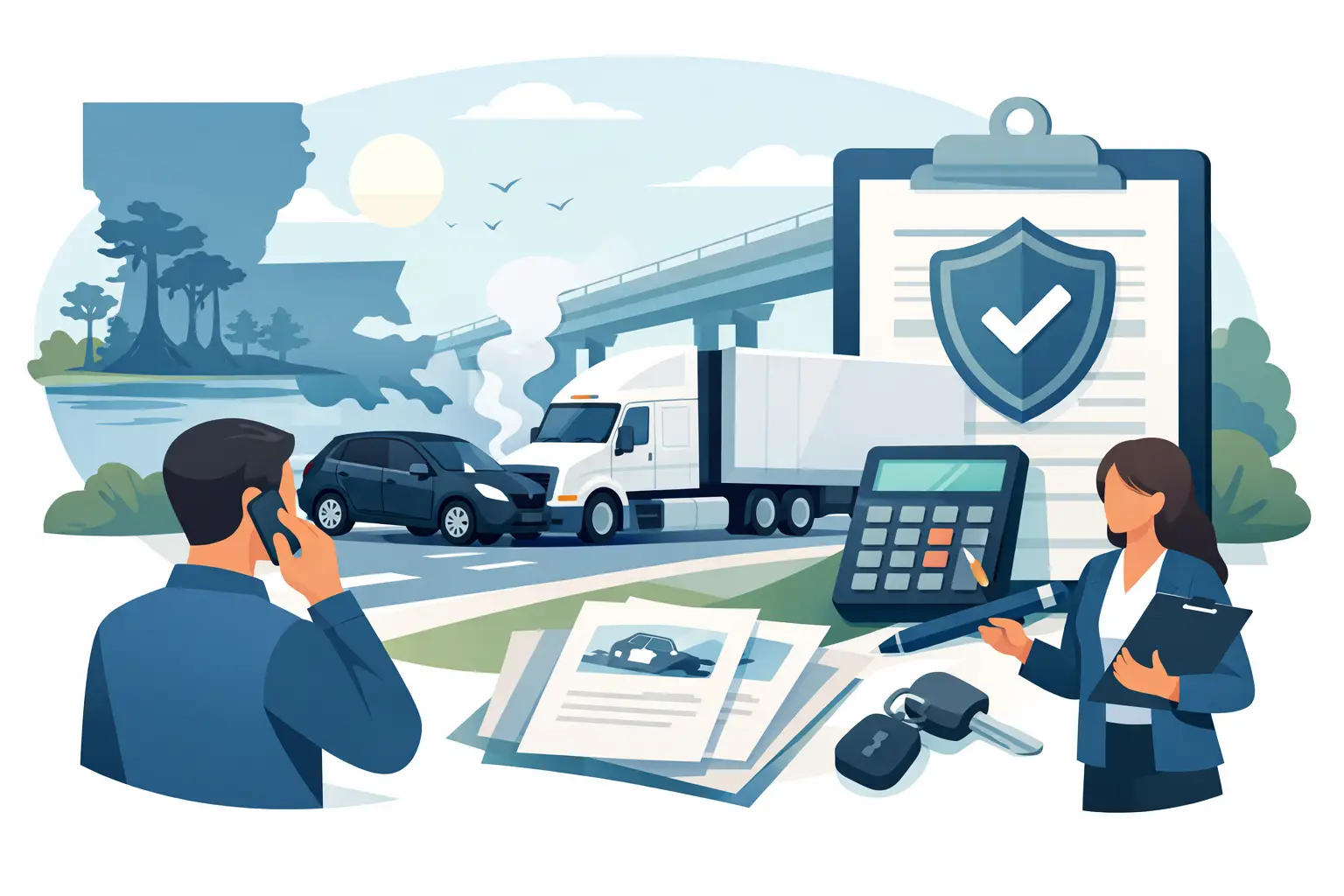


Louisiana Truck Accident Claim Guide: First Steps
A collision with an 80,000-pound commercial truck can change a family’s life in seconds. One moment, you are driving to work on I-10, heading home on Ambassador Caffery, or traveling a rural Acadiana highway. The next, you may be facing emergency treatment, time away from work, a damaged vehicle, and calls from insurance adjusters asking for answers before you have had time to process what happened.
This Louisiana truck accident claim guide explains the early decisions that can protect your health, preserve your claim, and give you a clearer path forward. Every crash is different, but truck cases usually demand faster action and deeper investigation than an ordinary car accident claim.
Why Truck Accident Claims Are Different
A serious truck wreck is not simply a larger version of a passenger-car crash. Commercial vehicles are governed by company policies, maintenance schedules, driver qualification rules, federal safety regulations, electronic tracking systems, and layers of insurance coverage. The evidence that shows why the crash happened may be in the hands of the trucking company from the first day.
The driver may have been speeding, distracted, fatigued, improperly trained, or under pressure to meet an unrealistic delivery schedule. The company may have failed to maintain its brakes or tires, allowed a driver to stay behind the wheel too long, loaded cargo improperly, or hired someone with a concerning driving history. In some cases, a manufacturer, freight broker, repair shop, or cargo-loading company may also share responsibility.
That is why the question is rarely limited to, “What did the truck driver do?” A careful claim looks at the entire operation from every angle.
What to Do After a Louisiana Truck Crash
Your first priority is medical care. Adrenaline can hide pain after a violent collision, and injuries involving the neck, back, brain, internal organs, or joints may not be fully apparent at the scene. Follow up promptly with a qualified medical provider, attend recommended appointments, and be honest about every symptom and limitation.
If you are able, preserve what you can. Keep photographs of the vehicles, roadway, visible injuries, skid marks, debris, and cargo. Save the names and contact information of witnesses. Request the crash report when it becomes available, but do not assume the report is the final word on fault. It is one important piece of evidence, not the whole case.
You should also keep practical records. Save medical bills, prescription receipts, repair estimates, towing invoices, work absence records, and written communications with insurers. A short daily record of pain, mobility problems, missed activities, and sleep disruption can help show the real human impact of an injury that may not be visible in a photograph.
Do not post about the crash or your recovery on social media. Insurance companies may look for posts, photos, or comments they can take out of context to argue that an injury is less serious than reported.
Preserve the Evidence Before It Disappears
Commercial trucking evidence can be lost, overwritten, or destroyed through ordinary business practices. Electronic control module data, dash camera footage, dispatch communications, GPS records, driver logs, inspection reports, and maintenance records can all matter. So can cargo documents, bills of lading, drug and alcohol testing records, and the truck driver’s employment and training file.
A prompt written preservation demand can put the appropriate parties on notice not to destroy relevant evidence. Waiting too long can make it much harder to establish whether the driver was speeding, braking late, driving beyond allowable hours, or operating a truck with a known mechanical problem.
Understanding Fault in a Louisiana Truck Accident Claim
Louisiana follows a comparative fault system. That means an injured person’s recovery may be reduced by their percentage of fault, but partial fault does not automatically prevent a claim. The details matter.
For example, a trucking insurer may claim a driver changed lanes too quickly or was traveling slightly over the speed limit. Those allegations must be tested against the evidence. Was the truck in a blind spot? Did the truck driver fail to signal? Was the roadway wet? Did the truck turn too widely, cross a center line, or make an unsafe merge? Did a mechanical failure contribute to the crash?
Insurers often move quickly to frame the story in a way that limits their payment. A strong investigation relies on physical evidence, witness statements, vehicle data, scene measurements, medical records, and, when necessary, accident reconstruction. The first version of events is not always the complete version.
Insurance Coverage Can Be Complicated
Truck wrecks can involve several insurance policies, each with different limits, exclusions, and arguments about responsibility. There may be coverage for the driver, the motor carrier, a trailer owner, a freight company, or another business connected to the shipment. Identifying every available source of coverage is a necessary part of evaluating a case.
The trucking company’s adjuster may sound helpful, but that adjuster works for the company and its insurer. A quick settlement offer can be tempting when bills are arriving and paychecks have stopped. The trade-off is serious: accepting a settlement usually means releasing the responsible parties from further liability, even if surgery, future treatment, or lasting disability becomes clear later.
Before agreeing to a recorded statement, signing medical authorizations, or accepting payment beyond basic property-damage arrangements, understand what is being requested and why. Broad medical authorizations can allow an insurer to search for unrelated medical history and use it to challenge a legitimate injury claim.
The Damages a Claim May Address
A truck accident claim should account for more than the emergency room bill. Depending on the facts, recoverable damages may include medical expenses, future treatment needs, lost income, reduced earning ability, vehicle and property losses, physical pain, emotional distress, scarring, disability, and loss of enjoyment of life.
For a self-employed worker, contractor, or small-business owner, the loss may include missed jobs, canceled contracts, and business income disruption. For a family facing catastrophic injury or a fatal crash, the financial and personal losses can be profound. A wrongful death claim may involve different damages and legal considerations than an injury claim.
The value of a case depends on the evidence, the severity and permanence of injury, available insurance, fault, and the effect the collision has had on the person and family involved. No responsible lawyer should promise a particular result before the facts are fully developed.
Deadlines Matter More Than Most People Realize
Louisiana filing deadlines can be unforgiving. For many tort claims arising from accidents on or after July 1, 2024, the general prescriptive period is two years. Claims arising before that date may be subject to the prior one-year period. Different rules, shorter notice requirements, or other deadlines can apply depending on the parties involved and the nature of the claim.
Do not treat the deadline as a target date. Evidence needs to be protected early, witnesses’ memories fade, and companies do not necessarily keep every record forever. Acting quickly gives your claim room to be investigated rather than rushed.
When a Work-Related Truck Crash Creates Two Claims
If you were driving for work, making deliveries, traveling between job sites, or were injured by a truck while performing your job, workers’ compensation may be part of the picture. Workers’ compensation can provide medical and wage-related benefits, but it may not cover the full range of losses available in a negligence claim.
Whether you can also bring a claim against a third party depends on who caused the crash and the working relationship between the parties. These cases require coordination because workers’ compensation insurers may assert reimbursement rights from a third-party recovery. The right approach protects your benefits while pursuing every available avenue of compensation.
Get Answers Before the Insurance Company Controls the Story
After a serious truck crash, you should not have to carry the investigation, paperwork, and pressure alone while trying to heal. McConnell Law Offices represents injured people and families across Lafayette and South Louisiana with the personal attention and trial readiness complex cases demand.
A confidential conversation can help clarify what evidence should be preserved, who may be responsible, and what steps make sense for your situation. The most helpful next step is often the simplest one: get medical care, protect the facts, and speak with someone prepared to stand up for your future.