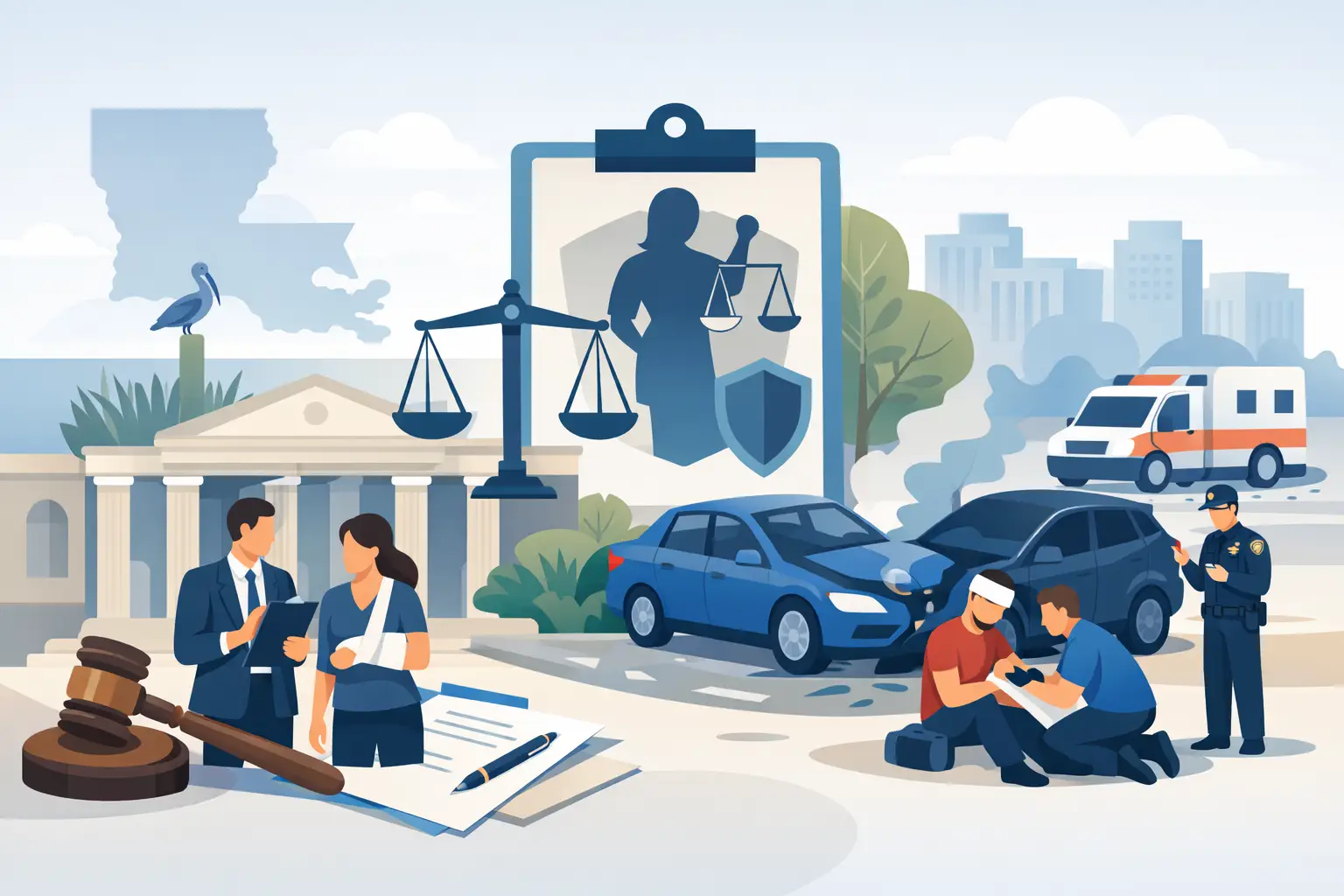


How Louisiana Injury Lawsuits Work After an Accident
A wreck on I-10, an injury at a Lafayette jobsite, or an offshore accident can change a family’s plans in seconds. Medical bills begin arriving, work becomes impossible or painful, and an insurance adjuster may call before the full extent of the injury is clear. Understanding how Louisiana injury lawsuits work can help you protect your options while you focus on healing.
An injury claim is not just a request for payment. It is a legal effort to hold the party responsible for an accident accountable for the harm it caused. Most claims resolve through settlement, but a fair result sometimes requires a lawyer who is prepared to file suit, build the evidence, and take the case to court.
How Louisiana Injury Lawsuits Work Step by Step
Every case has its own facts, but most Louisiana injury cases follow a familiar path: medical care and investigation, an insurance claim and settlement negotiations, then litigation if the insurer or responsible party will not offer fair compensation.
The process often begins before a lawsuit is filed. After a car crash, for example, an injured person may seek emergency treatment, follow up with a doctor, report the collision to the appropriate insurers, and preserve photographs or contact information from the scene. In a workplace, maritime, or trucking case, early investigation can be even more important because records, equipment, surveillance footage, and witnesses may become harder to locate with time.
A lawsuit becomes necessary when there is a genuine dispute over fault, the severity of the injuries, available insurance coverage, or the value of the losses. Filing suit does not mean a case is destined for trial. It means the injured person has formally asked the court to decide the dispute if a voluntary agreement cannot be reached.
Medical treatment creates more than a paper trail
Getting appropriate medical care is first about your health. It also gives doctors the opportunity to identify injuries that may not be obvious immediately after an accident, including concussions, disc injuries, internal injuries, and trauma that worsens over time.
Medical records help show the connection between the incident and the harm suffered. They may document diagnoses, treatment plans, work restrictions, medication, physical therapy, future care needs, and the effect of an injury on daily life. Skipping recommended treatment or waiting too long to be evaluated can give an insurer room to argue that the injury was unrelated or less serious than claimed. That does not automatically defeat a case, but it can complicate it.
Proving Fault and Preserving the Evidence
To recover in a typical negligence case, an injured person must show that another party failed to act with reasonable care and that the failure caused legally compensable harm. A distracted driver, a trucking company that ignored safety rules, a property owner who allowed a dangerous condition to remain, or an employer or contractor that created an unsafe work environment may all face different forms of liability.
The evidence depends on the accident. A collision case may involve the crash report, vehicle damage, scene photos, video, witness statements, cell phone records, and accident reconstruction. A serious workplace or offshore injury may require maintenance records, training documents, company policies, inspection reports, incident reports, vessel records, and testimony from coworkers or safety experts.
Insurance companies begin evaluating a claim early. So should the injured person. Keep copies of bills, wage records, prescriptions, photographs, correspondence, and notes about how pain or limitations affect work and home life. Avoid posting details about the accident, physical activity, or the claim on social media. A single image or statement can be taken out of context and used to challenge an injury claim.
Insurance negotiations often come before a lawsuit
Once the available facts and medical information are developed, the injured person’s attorney may present a demand to the insurer. The demand explains why the insured person or business is responsible and identifies the losses being claimed. The insurer may investigate, request records, dispute fault, question treatment, make an offer, or deny the claim.
An early offer can be tempting when bills are piling up. But accepting a settlement usually means giving up the right to seek additional compensation later, even if surgery becomes necessary or the injury prevents a return to work. The right time to settle depends on the medical outlook, the strength of the evidence, the insurance coverage, and the client’s needs. Some cases can resolve efficiently. Others should not be rushed.
What Happens When a Louisiana Injury Lawsuit Is Filed?
A lawsuit formally starts when the injured person, called the plaintiff, files a petition in the proper court. The petition identifies the parties, explains the basic allegations, and asks for damages. The defendant is then served with the legal papers and has an opportunity to respond.
After the case is filed, both sides enter discovery. This is the fact-gathering stage, and it is often where the true strength of a case becomes clear. Each side can request documents, submit written questions, and take depositions. A deposition is sworn testimony given outside the courtroom, usually with a court reporter present.
For a person recovering from an injury, discovery can feel personal. The defense may ask about prior injuries, medical history, employment, activities, and the events surrounding the accident. Honest, well-prepared answers matter. The goal is not to exaggerate a claim. It is to present a complete and credible account of what happened and what the injury has cost.
Many cases are also evaluated through mediation or settlement conferences. A neutral mediator may help the parties negotiate, but cannot force either side to accept an agreement. If the case does not settle, it may proceed to trial, where a judge or jury decides disputed issues of fault and damages.
Damages Can Include More Than Medical Bills
Louisiana law may allow an injured person to pursue compensation for the financial and human consequences of an accident. Depending on the facts, damages may include past and future medical expenses, lost wages, reduced earning capacity, property damage, pain and suffering, mental anguish, disability, disfigurement, and loss of enjoyment of life.
For a family business owner, missed work may mean lost business income, not just a missed paycheck. For a construction worker, driver, offshore worker, or nurse, physical restrictions can threaten a career built over decades. These losses require careful proof. Tax records, payroll documents, expert opinions, and testimony about job duties may all be relevant.
Louisiana uses a comparative fault system. That means an injured person can still recover damages even if they were partly at fault, but the recovery may be reduced by their percentage of responsibility. Insurers frequently try to shift blame. A careful investigation is essential when fault is disputed.
Deadlines and Special Rules Matter in Louisiana
Timing can decide whether a valid claim can be heard at all. Louisiana recently changed the general deadline for many injury claims, and the applicable period can depend on when the injury occurred. Claims arising before July 1, 2024 may be subject to different deadlines than many claims arising afterward. Medical malpractice, claims involving government entities, workers’ compensation matters, wrongful death claims, and maritime or offshore cases can involve separate rules, notice requirements, or deadlines.
Do not assume an insurance claim preserves your right to sue. In many situations, it does not. Waiting also makes it harder to preserve evidence and locate witnesses. Speaking with a Louisiana injury attorney early can clarify which law applies and what action must be taken.
Workers’ compensation deserves special attention. An employee injured at work may have a workers’ compensation claim for medical care and wage benefits, but may also have a separate claim against a negligent third party, such as a driver, contractor, equipment manufacturer, or property owner. Offshore and maritime workers may have rights under federal maritime law rather than ordinary Louisiana negligence rules. The details matter.
A Case Should Be Built Around Your Life, Not an Insurance Formula
Insurance companies often rely on formulas, software, and internal guidelines. Your recovery should reflect the evidence of your actual losses. A complete case tells the story behind the records: the parent who cannot lift a child, the worker who cannot return to the field, the spouse carrying new responsibilities, or the family mourning a loss that should never have happened.
McConnell Law Offices approaches injury claims with a trial-ready mindset and the personal attention South Louisiana families deserve. A free, confidential conversation can help identify the evidence to preserve, the deadlines to watch, and the path that makes sense for your circumstances.
After an accident, you do not need to have every answer before asking for help. Protect your health, save what you can, and get clear advice before an insurer’s timeline becomes your timeline.